Finding Your Next, Best Job
One of the great joys in my career has been building teams - small, sharp, technical groups that take an idea from zero to “wow” and launch. Along the way, I've hired and coached many people on career transitions. Now, I often meet people in transition on their own paths, many of whom are considering starting a company or joining a startup. They’re looking for their next gig or trying to figure out what “better” looks like. And sooner or later, they ask me the same question:
“How do I find the right job or the right next step in my career? ”
I usually flip that question around. Because the clearer you are, the more easily I can help. The same goes for anyone in your network. And honestly, these questions aren’t just for job-seekers; they work beautifully in any interview, mentoring conversation, or personal self-reflection cycle. Since it's December and we're all considering a new year, it's a good practice to do this for yourself anyway.
So here are the questions I often ask. Spend real time with them. Write the answers down (in a Google Doc so you can share and get feedback). Iterate. The more specific you get, the faster the path becomes.
Tell me about your next perfect job.
If everything lined up—role, team, category, customer focus, stage, impact—what does that look like? Forget titles for a moment, though they sometimes help in seniority, level of responsibility, and expectations on compensation. Think about the work. Think about the people. Think about the feeling at the end of a great day.
One way I ask this is, "In your perfect job, and if you looked at your calendar in retrospect 6 months from the day you started (in your new role), how would you have spent your time, % doing X, % doing Y...?" What kinds of work or tasks give you the most satisfaction?
If you can articulate this, you’re already ahead of 90% of people.
What kinds of problems do you want to solve?
Some people love messy, ambiguous zero-to-one environments. Others love optimizing systems already in flight. Some want hard technical puzzles; others want hard human ones. Knowing your preferred problem space is a superpower.
What technology do you want to work with?
You don’t need to chase every new shiny object, but you should understand what excites you. “I want to work with AI agents,” or “I love early-stage cloud infrastructure,” or “I want to be closer to hardware.” This helps narrow the universe of opportunities.
What "stage" is the company you want to join?
Startups and established companies are very, very different. Fast-moving, dynamic companies (e.g., OpenAI) vs. well-formed and slower-moving companies (e.g., John Deere) are very different, too. Maybe this seems obvious, but knowing which stage of a company you want to join is essential. And since I work primarily in startups, knowing the difference between being a founder and joining a newly formed company (2-10 employees), a seed-stage company (10-25 employees), and a Series A company (25-100 employees) is also very important. As you go smaller, you get more say in what's going on and where you're going, and you will need to be more interested in a broader range of skills and tasks. You are also likely to be paid less as you go smaller. It also carries the most significant risk of change, but that comes with the highest level of excitement, learning opportunities, upside, and impact. I'm a 5-time founder, so I know what that feels like, especially in a success case. Know your stage.
Who do you want to work with?
You spend so much time with your co-workers; you should try to find people you like, respect, and can have beers with after work, and who you're excited to be around.
What do you want to learn?
Great careers compound. They’re built on layers of directed learning. So what’s the next layer for you? Maybe it’s product strategy, maybe it’s distributed systems, maybe it’s how to manage up effectively. Be explicit—this shapes which roles will actually grow you. This will also help you set goals with your new co-founder or manager.
Magic wand time. If I could get you any job at any company, what would it be—and why?
Whenever I ask this, people either light up or freeze. If you can name three dream jobs or dream companies, even better. This isn’t about wishful thinking—it’s about understanding directionality and why you think you would be excited to do that kind of work, for those kinds of customers, using those kinds of strategies/tools, and likely those kinds of people.
Your dreams contain data.
Who has this job today?
Go find the LinkedIn profile of someone doing the role you want. Compare your skills to theirs. Not with insecurity, but with clarity. Where are the gaps? What have they done? What do they talk about? What can you emulate?
Reverse-engineering is wildly underrated.
If you already know the job you want, what are you doing to get it?
Are you building the right skills? Meeting the right people? Shipping the right projects? Do you need coaching? More reps? A stronger portfolio? Should you be working on side projects that build skills or networks? Be honest—momentum matters. Why not reach out directly to the people who have the role now and ask them how to get on the path?
If you’re still early or broad, start with these:
• What kinds of customers do you want to hang around with?
Enterprise? SMBs? Developers? Consumers? Athletes? Healthcare providers? You’ll be spending a lot of time thinking about these people—make sure you like them.
• Do you have a vertical focus?
Fintech, healthtech, climate, AI tools, commerce… Knowing the “world” you want to live in creates tremendous clarity. Study the key trends in this vertical and the breakout companies. Does this study give you more energy and ideas about the space? No matter if you start a new company or join an existing one, being excited and informed about the category matters!
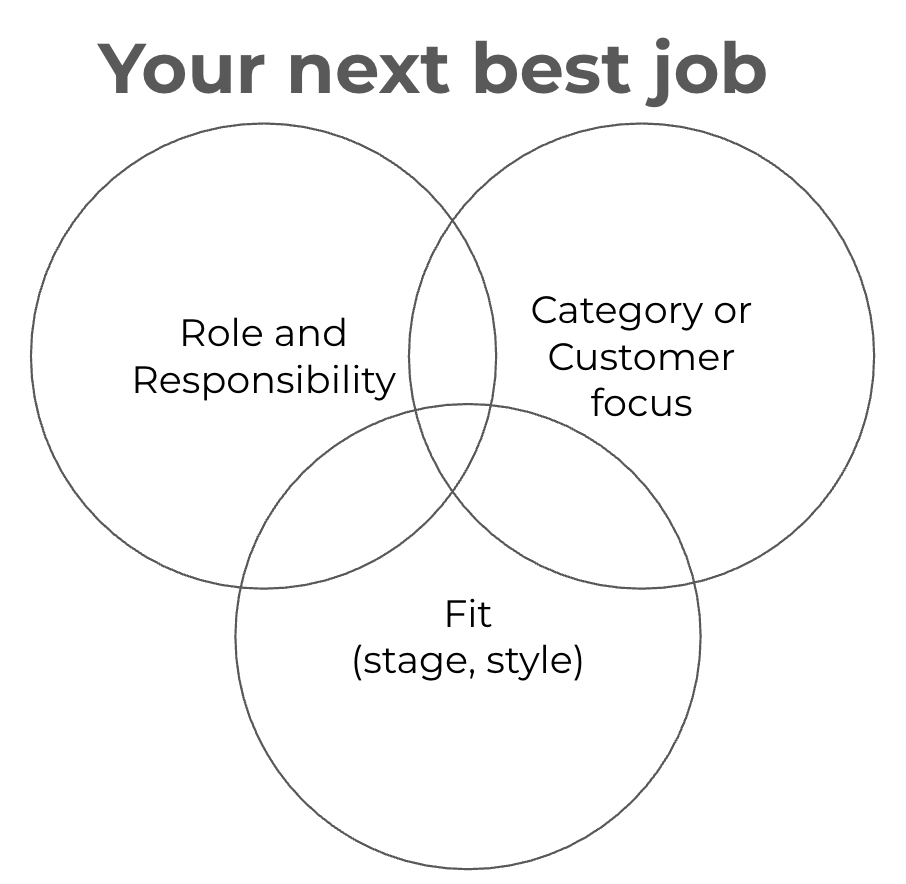
Look backward once: What was your biggest accomplishment in your last role?
Not the fluff—the thing that moved the needle. How did you measure its value? What did it do for the company? And what did it do for you? Why did it give you energy? Being able to articulate your impact clearly is one of the strongest signals you can send a future team.
Finding your next job is not about scrolling through job boards, unless that inspires you. It’s about clarity—about knowing what you want, why you want it, and how you plan to get there. Once you have that clarity, people like me can help you much more effectively. And, if you want to meet with me, please do a first pass on the Google Doc and share it before our first meeting.
The better you can answer these questions, the faster the right opportunities find you—and the faster you can get back to doing what you’re great at: building cool stuff with great people.