The Startup Fluency Gap: Why We Built Lev Learn
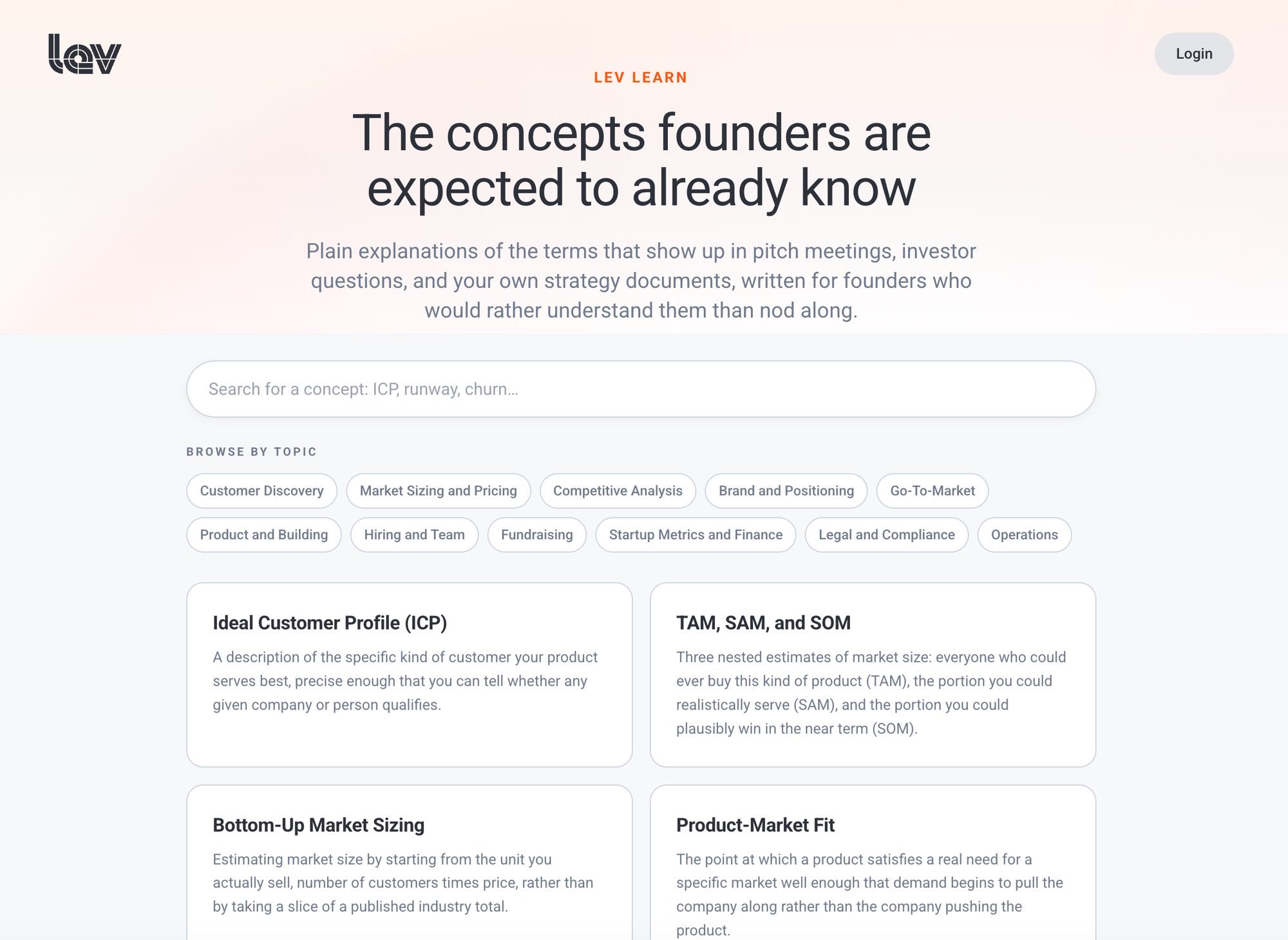
I've sat across the table from hundreds, maybe thousands, of founders by now. Techstars, CDL, UW, WTIA, PSL, the studio floor. And the same moment keeps repeating itself. A founder is sharp, capable, building something real, and then they hit a word... Burn multiple. SAFE note. ICP. They nod as if they know it, and I can tell they don't, and I don't blame them. Nobody handed them the dictionary.
I call this the startup fluency gap. It is neither a knowledge gap nor a talent gap. It is the distance between doing the work and having the vocabulary to talk about the work with the people who fund it, hire for it, join it, and advise it. And that gap does not just sit with founders. Founding teams, investors, advisors, and mentors all need the same fluency to actually communicate with each other, or every conversation is a translation exercise before it is a real conversation. Close the gap and a room moves faster. Leave it open, and everyone burns cycles re-deriving things that already have names.
Where the words come from
I didn't learn this language on my own. Brad Feld's writing on venture deals and startup communities is where I actually understood what a term sheet does, not just what it says, and gained some understanding of the importance of liquidation preferences. Dave Parker's frameworks on go-to-market and operating a company shaped how I coach founders through the unglamorous middle of building something. Steve Blank gave founders customer development and the whole discipline of getting out of the building to find product-market fit before you scale a thing nobody wants. Eric Ries took Blank's thinking and gave a generation the words "minimum viable product" and "validated learning," and in doing that he changed how people actually build, not just how they talk about building. Paul Graham's essays gave early-stage founders a working vocabulary for survival itself, ramen profitable, default alive versus default dead, the language people reach for when a startup is still just trying to not die. Geoffrey Moore's "Crossing the Chasm" gave everyone the map for how adoption actually spreads, the chasm, the early and late majority, the language that sits right alongside a founder's first ICP and VOC work. Fred Wilson has spent two decades on AVC quietly translating venture mechanics, vesting, option pools, board dynamics, into plain language any founder can actually use in a negotiation. Jason Lemkin gave SaaS founders the metrics vocabulary that now shows up in every board deck: NRR, magic number, rule of 40. Sean Ellis coined "growth hacking" and built the PMF survey test that is still the closest thing founders have to an objective read on whether they have found product-market fit. And the list goes on. Every discipline a founder touches, product, sales, finance, hiring, has its own lineage of people who did this same work, and Lev Learn is built to keep growing into all of it, not just the names I happen to know best.
Closer to home, my partners Greg Gottesman and Geoff Entress have spent years teaching every founder (and me) who walks through PSL how to actually talk about financing, as well as a host of best practices for company building. Priced rounds versus SAFEs, what a cap actually protects, how a discount changes the math, what a board really wants to hear in a financing update. That is not textbook language. That is the language you only get from people who have sat on the other side of the table dozens of times and are generous enough to explain why the terms matter.
None of these people just wrote books or ran board meetings. They named things clearly enough that the names stuck, and once a term sticks, it becomes infrastructure. Every founder who says "MVP" today is standing on Ries's and Blank's work, whether they know it or not. That is the model. Lev Learn is our attempt to keep building that infrastructure and to make sure the words different authors use actually line up rather than drift apart. Many of these frameworks were built independently by people who never sat in the same room. Part of what Lev Learn does is extend and align that vocabulary across authors, so a founder is not left guessing whether Blank's "early evangelists" and someone else's "early adopters" are the same idea wearing a different name.
This is not abstract. Take a sequence I walk founders through constantly: ICP--> VOC-->EAC. ICP, then VOC, then EAC. Nail down your Ideal Customer Profile, go test it through real Voice of Customer conversations, and use what you learn to find your Early Adopter Customers. Miss any one of those three terms, and you miss the actual point of the process, not just the label for it. That is the fluency gap in miniature, and it repeats itself across dozens of concepts that a founder needs to navigate in a single fundraise or product cycle. Many of the posts on my blog here attempt to introduce a new concept or terms (e.g. WWI/KKO), so I'm making my own contributions too.
Where a glossary usually fails
Most glossaries live outside the work. You Google a term, skim a definition, and forget it thirty seconds later because it never touched what you were actually doing. That is a reference problem, not a learning problem, and it is why glossaries rarely change behavior.
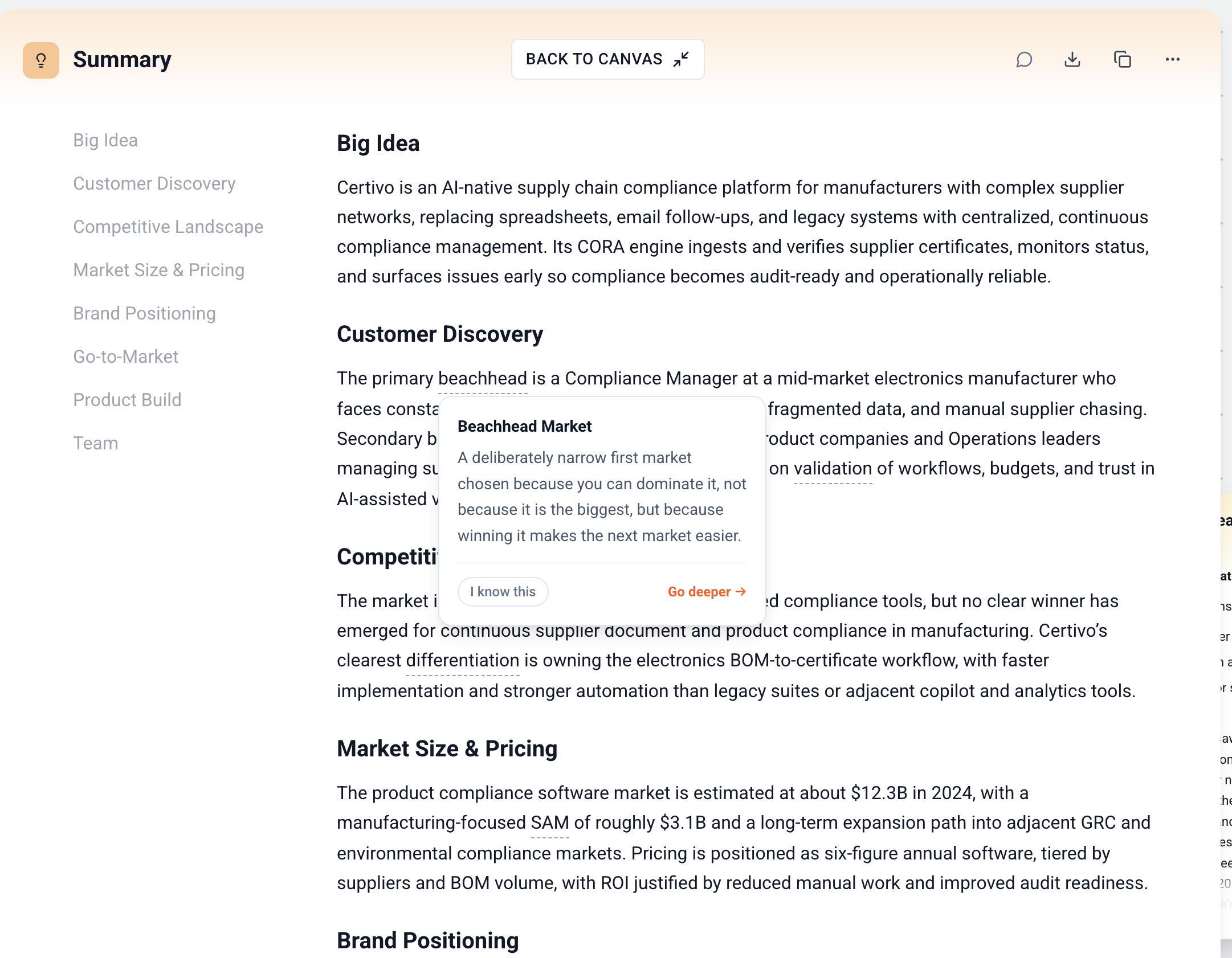
Lev Learn is built to solve that two ways. It lives as its own standalone site, so anyone (founder, teammate, investor, advisor) can search it directly without touching the product at all. And it is woven into the Lev application itself, so when a founder is heads down on market sizing, pricing and packaging, fundraising, or go-to-market, the relevant terms sit right there in context, tied to the task and to their own company. Knowing the textbook definition of "beachhead market" is trivia. Knowing yours while you are staring at your own model is leverage.
What this replaces, and where it grows
For years, the honest answer to "what does this term mean" was "come ask me" or "go ask a mentor." That does not scale. I cannot sit across from every founder who needs it, and neither can any single mentor, no matter how many office hours they hold. Lev Learn is the scaled version of that same conversation, available the moment anyone on a founding team, a board, or a cap table needs it.
It is also not finished, and it is not supposed to be. If there is a term you think founders, investors, or advisors should know and it is not in there yet, suggest it. We are actively growing this glossary, and we are likely to add it.
Lev exists to help founders succeed. That is the whole premise of an AI co-founder. Lev Learn is one more piece of that: a searchable, always-on glossary that closes the fluency gap right where it opens, for everyone around the table, not just the founder.
Try it at getlev.co.
A last word of thanks. None of this vocabulary is mine alone. Brad Feld, Dave Parker, Steve Blank, Eric Ries, Paul Graham, Geoffrey Moore, Fred Wilson, Jason Lemkin, Sean Ellis, and the many others whose names belong on this list too, spent careers naming things clearly enough that the rest of us could build on them, and my partners Greg Gottesman and Geoff Entress have been just as generous teaching this language in rooms that never made it into a book. Every founder who becomes fluent faster thanks to Lev Learn is really benefiting from their foundation. I am grateful to all of them, and to the hundreds of founders who, in asking me to explain a term one more time, showed me exactly where the gap was.